
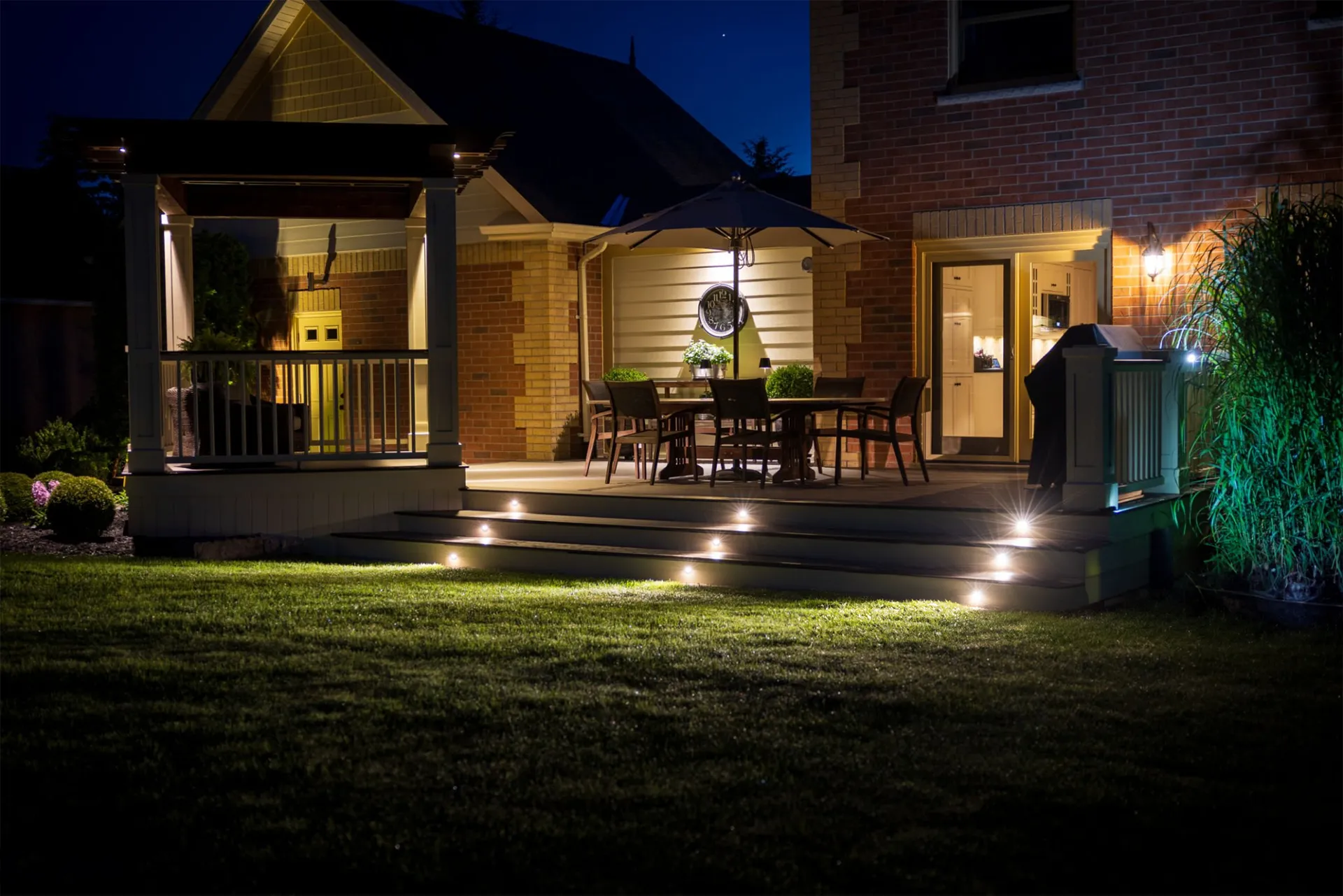
Oxford homeowners build decks for sunset cocktails, late dinners with family, and evening conversations that stretch well past dark. Without proper lighting designed into the build, all of those moments come with a flashlight, a stumble down the stairs, or an early retreat indoors when the sun drops behind the Litchfield hills. A well-lit deck extends the usable hours of the space dramatically, but only when the lighting plan goes in before construction begins.
This guide walks through how to plan step, railing, and post lighting before the first board is fastened, why this timing matters in Connecticut conditions, and what to expect from a professional deck lighting installation that integrates lighting into the structure itself rather than tacking it on later.
Why Lighting Belongs in the Design Phase
Deck lighting is structural before it is decorative. Wiring runs through the joist cavity, transformers mount inside the framing, and fixture locations dictate exactly where boards get cut and where post sleeves get drilled. Trying to add these elements after the deck is complete means lifting boards, fishing wire through finished surfaces, and patching holes that never quite blend back into the original work cleanly.
Designing the lighting plan during the same consultation as the deck itself costs a fraction of what retrofit installation requires. The contractor maps every fixture location, every conduit run, every transformer position, and every switch placement before the first joist hanger goes in. This planning keeps the install clean, hides the wiring entirely, and delivers a finished result that looks like an integrated system rather than an afterthought stapled to existing framing.
Step Lights and Stair Safety
Step lights are the single most important lighting category on any Oxford deck. Stairs become hazards after dark, especially on multi-level builds where guests move between zones without realizing where the elevation changes between sections. Recessed step lights mounted into the riser eliminate the risk by casting a soft, even light directly onto each tread without creating glare in the eyes of anyone climbing the stairs.
These fixtures must be planned before the stair stringers go in, since the wiring runs through the framing and the mounting holes get cut into the riser boards during fabrication. Quality deck lighting installed at the stair level prevents falls, meets safety standards, and adds a polished architectural feel that retrofit clip-on options can never replicate convincingly. The cost difference between planned and retrofit installation is significant.
Post Cap and Railing Lights
Post cap and railing lights serve a different purpose than step lights, which is creating ambient illumination across the deck surface itself. Post caps mount on top of railing posts and cast light downward across the deck floor, while integrated railing lights tuck into the underside of top rails or balusters to create a soft glow along the entire perimeter of the structure for both safety and atmosphere.
Quality deck lighting from In-Lite, Tru-scapes, and TimberTech delivers post cap and railing fixtures built specifically for outdoor environments. These brands carry sealed connections, marine-grade finishes, and warranty coverage that matches the deck itself. Planning the post cap locations during the railing design phase ensures the wiring runs cleanly through the posts rather than being draped across the surface visibly after the fact.
Wiring, Electrical, and Lighting Automation
The wiring behind a clean lighting plan is invisible, which is exactly why it matters so much. Cables run through pre-drilled holes in the joists, junction boxes mount inside the framing, and the only thing visible after install is the fixture itself. Achieving this finish requires coordination between the deck builder and the licensed electrician from day one of the project, not as a separate add-on at the end.
Lighting automation has become a standard request in modern Oxford builds. Smart-ready deck lighting connects through low-voltage transformers, dedicated control hubs, or Wi-Fi systems that let homeowners schedule lighting, dim individual zones, and control everything from a phone. Landscape lighting integration also ties the deck lighting into pathway lights and yard fixtures for a unified outdoor system across the entire property.
Choosing the Right Contractor for the Job
The cleanest lighting installations happen when the deck builder, the electrician, and the lighting designer work together as a single team from the start. A contractor who handles design consultation, framing, wiring coordination, automation programming, and fixture installation as one coordinated project delivers a result that looks and functions like a finished system rather than a stack of separate upgrades stitched together over multiple visits.
Asking about lighting during the initial consultation tells you a lot about how a builder approaches the entire project, including their attention to detail, their coordination process, and their familiarity with code requirements for outdoor electrical work in Connecticut. For expert deck lighting design and installation in Oxford and across the surrounding Connecticut communities, contact Outdoor Space Builders at (203) 715-7853 to schedule a consultation and plan your build the right way from the first sketch to final flip of the switch.